Can you solve the case of “A Portrait Without a Face”? Discover local watering wholes, history, ghost stories and collect clues! CLICK HERE or register below. CLICK HERE to access our deluxe Corporate Team Building DIY Scavenger Hunt Kit.
More history per cobblestone than anywhere else in America...
Colonial Americans, Revolutionaries, Pirates, Gangsters, and now you ate and drank along these historic streets. Now solve the murder!
Solve the mystery of “A Portrait Without a Face” on an interactive Murder Mystery Pub Crawl that blends history, ghost stories, and a quest for justice. This theatrical adventure leads you through legendary watering holes and former gang headquarters where you will collect clues, interrogate a captivating cast of characters, and encounter lingering spirits to identify the culprit. The experience functions as an immersive investigation, encouraging participants to stay after the tour to enjoy the local food, drinks, and entertainment found along the route.
Please wear comfortable walking shoes, as the show involves traveling between several stops on foot. Dress appropriately for the season and current weather conditions to ensure a comfortable outdoor experience. We ask that all guests remain respectful of the neighborhood and the local establishments we visit throughout the journey.
HAVE SOME REAL FUN and dress the part?
- CLICK HERE for costume ideas for colonial America.
- CLICK HERE for 1920s costumes for men.
- CLICK HERE for 1920s costume ideas for women.
THE CORPORATE TEAM BUILDING KIT
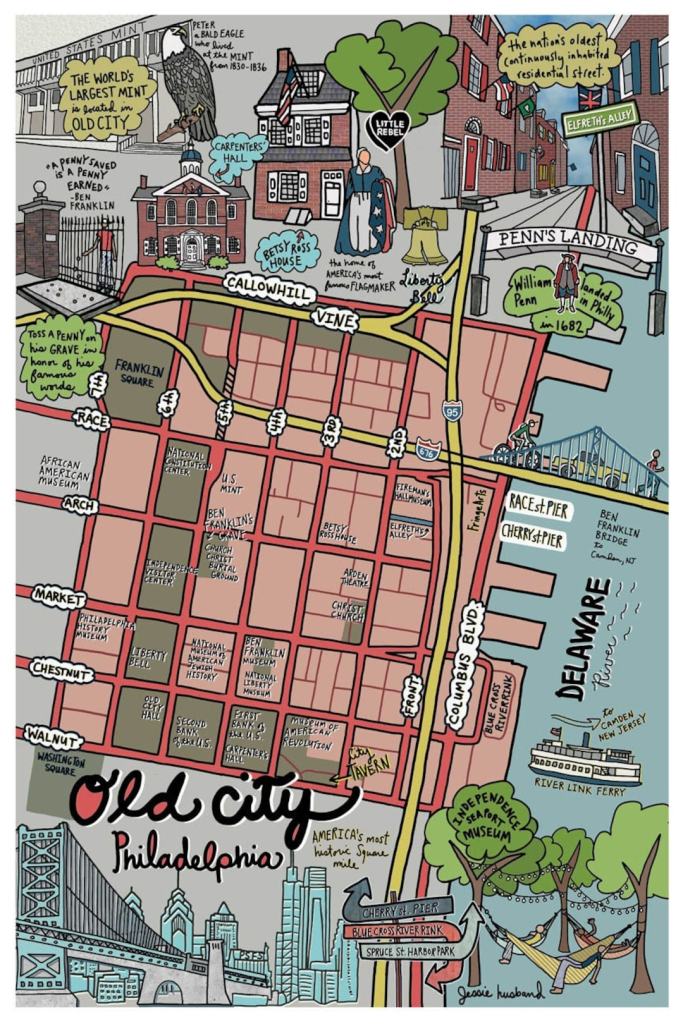
Haunted Historical Murder Mystery Pub Crawl, Scavenger Hunt and Trivia Event DIY Kit for Olde City Philadelphia PA
Treat the office to a scavenger hunt like no other. We design corporate team building events that range from $500-$5000+. But this kit has everything you need for a fun afternoon/evening.
Your Kit includes:
- Selfie Scavenger Hunt TEN Stop Tour of Old City and numerous Bonus Haunted Historical Sites
- Murder Mystery, with new clues and characters introduced at every major stop.
- Scan the QR code to access the webapp (nothing to download, works from any phone/device). The app includes fun facts, including Historical and Paranormal trivia as well as the murder mystery script featuring ten characters: a victim plus nine suspects.
- Team up to complete the tour and solve the murder.
- This DIY kit also includes a 20 question trivia quiz.
Here are your stops:
THE 10 MAIN STOPS
- The President’s House — 598 Market St, Philadelphia, PA 19106 (Also Liberty Bell, Independence Hall)
- Independence Beer Garden — 100 S Independence Mall W, Philadelphia, PA 19106
- Craftsman Row — 112 S 8th St, Philadelphia, PA 19107 (Also Walnut Street Theatre)
- P.J. Clarke’s — 601 Walnut St, Philadelphia, PA 19106
- A Man Full of Trouble — 127 Spruce St, Philadelphia, PA 19106
- Spasso Italian Grill — 34 S Front St, Philadelphia, PA 19106
- Rotten Ralph’s — 201 Chestnut St, Philadelphia, PA 19106
- Cuba Libre Restaurant & Rum Bar — 10 S 2nd St, Philadelphia, PA 19106
- Fork — 306 Market St, Philadelphia, PA 19106
- Red Owl Tavern — 433 Chestnut St, Philadelphia, PA 19106
BONUS STOPS
- Washington Square — 210 W Washington Square, Philadelphia, PA 19106
- Thomas Sully Residence — 530 Spruce St, Philadelphia, PA 19106
- Old Saint Joseph’s Catholic Church — 321 Willings Alley, Philadelphia, PA 19106
- The Irish Memorial — 109 Spruce St, Philadelphia, PA 19106
- Blue Anchor Tavern Site — Front St & Dock St, Philadelphia, PA 19106
- Independence Seaport Museum (Waterfront Loop) — 211 S Christopher Columbus Blvd, Philadelphia, PA 19106
- Benjamin Franklin Bridge — Ben Franklin Bridge Walkway, Philadelphia, PA 19106
A History of Philadelphia’s Old City
There is a stretch of Philadelphia, roughly bounded by the Delaware River to the east, Walnut Street to the south, Sixth Street to the west, and Market Street to the north, that may contain more history per cobblestone than anywhere else in America. It is a place where the ideals that founded a nation were debated and signed into existence, where pirates unloaded plunder under the noses of complicit governors, where Prohibition-era gangsters moved bootleg liquor through tunnels still buried beneath your feet. Today, that same square mile hums with craft breweries, James Beard-recognized restaurants, and stages that have hosted the greatest performers in the world. To walk through Old City Philadelphia is to walk through the entire American story — the noble and the criminal, the visionary and the corrupt, all layered one on top of another like sediment in the earth.
The Ground Beneath the Ideal
Before there was a United States, there was this block. In the 1770s, the State House yard at the corner of Fifth and Chestnut was the unlikely crucible of a democratic experiment that would reshape the world. Inside Independence Hall — then known simply as the Pennsylvania State House — delegates from thirteen fractious colonies gathered to argue, compromise, and ultimately sign the Declaration of Independence in 1776. A decade later, the same room witnessed the drafting and ratification of the Constitution, the framework of governance that still governs three hundred million people today.
But history has always been more complicated than its monuments suggest. Just steps from the Liberty Bell — that 2,080-pound icon of freedom with its famous crack — stood the President’s House, where George Washington and John Adams lived while Philadelphia served as the nation’s capital. Beneath the floorboards of that house, nine enslaved people lived and worked, their existence a shattering counterpoint to the proclamations of liberty being made nearby. The excavated foundations of that residence, now exposed beneath glass for all to see, serve as an essential reminder: the ideals born in this square mile were not yet practiced within it.
A Lawless Shore
While the founders were busy declaring principles, the waterfront a few blocks to the east was operating by an entirely different code. In the late 17th and early 18th centuries, the Delaware River piers of Philadelphia were among the most active — and most corrupt — in the New World. Colonial governors routinely turned a blind eye to piracy, accepting gold and exotic goods in exchange for docking rights and discretion. Edward “Blackbeard” Teach was said to be a familiar face in the alehouses along the original shoreline, and historical records confirm his crew moved freely through the city’s taverns.
The oldest surviving evidence of that waterfront world is A Man Full of Trouble, a tavern on Spruce Street built in 1759 and the only colonial-era alehouse still standing in Philadelphia. It served sailors, dockworkers, and likely worse, and its basement once connected to a network of tunnels running toward the river. Staff to this day report strange sounds rising from below — which, given what those tunnels witnessed, is not entirely surprising.
The waterfront also saw some of the most consequential military action of the Revolutionary War. In 1777, British warships attempting to sail up the Delaware met an ingenious underwater defense: chevaux-de-frise, massive iron-tipped wooden frames sunk into the riverbed to impale enemy hulls. The HMS Augusta caught fire and exploded in the attempt. These battles, now largely forgotten, were critical to keeping the young nation’s capital from falling entirely into British hands.
The Shadow Economy
The 19th century brought industrialization and immigration, transforming the waterfront from a pirate haven into a roaring commercial engine. But with commerce came crime, and by the time Prohibition arrived in 1920, Old City was already a well-organized shadow economy waiting to go underground.
Philadelphia’s Prohibition story is less cinematic than Chicago’s but arguably more sophisticated. Rather than open warfare, the city operated as an “open town,” where bribes flowed upward and the headlines stayed quiet. Max “Boo Boo” Hoff, who held court around Washington Square, built an empire of high-society drinking clubs while the police looked the other way. His successor, Harry “Nig” Rosen, a founding member of the national crime syndicate alongside Meyer Lansky, controlled the Delaware River piers, diverting industrial alcohol from local perfume and chemical factories through the narrow alleys of Old City to speakeasies across the city.
Even Al Capone left his mark. In 1929, the Chicago gangster was arrested outside a Philadelphia movie theater carrying a concealed revolver and spent nine months at the nearby Eastern State Penitentiary — reportedly in comfortable conditions, though historians suspect the reported luxury was mostly press embellishment.
Meanwhile, a decorated Marine general named Smedley Butler was appointed Director of Public Safety in 1924, tasked with cleaning up the city. He found the rot went all the way to the top, and his tenure was as turbulent as the times demanded.
Revival and Renaissance
The latter half of the 20th century saw Old City transform again, this time into a destination for culture, cuisine, and community. The Walnut Street Theatre, which has operated continuously since 1809 and is the oldest playhouse in America, never stopped drawing world-class talent — from Edwin Booth to Marlon Brando in its earlier decades, to a full season of Broadway-caliber productions today. It remains the anchor of a performing arts scene that punches well above Philadelphia’s weight class.
The food renaissance arrived in earnest in the 1990s. Restaurants like Fork, which opened on Market Street in 1997, helped redefine what a neighborhood bistro could be, drawing national attention and helping cement Old City’s identity as a culinary destination. The craft beer movement followed, reclaiming historic buildings — including the site of the old Rohm and Haas headquarters, now Independence Beer Garden — and filling them with 40-tap bars and communal fire pits.
Today, Old City is a living palimpsest. Tourists photograph the Liberty Bell in the morning. Office workers eat Branzino at Spasso at lunch. Friends do a pub crawl past the ghost of Blackbeard’s old haunts at night. Beneath every restaurant patio, every brewery floor, every cobblestoned alley, the layers remain — colonial idealism and pirate pragmatism, gangster ambition and revolutionary courage, all compressed into one remarkable square mile that the rest of America was, in many ways, built to explain.