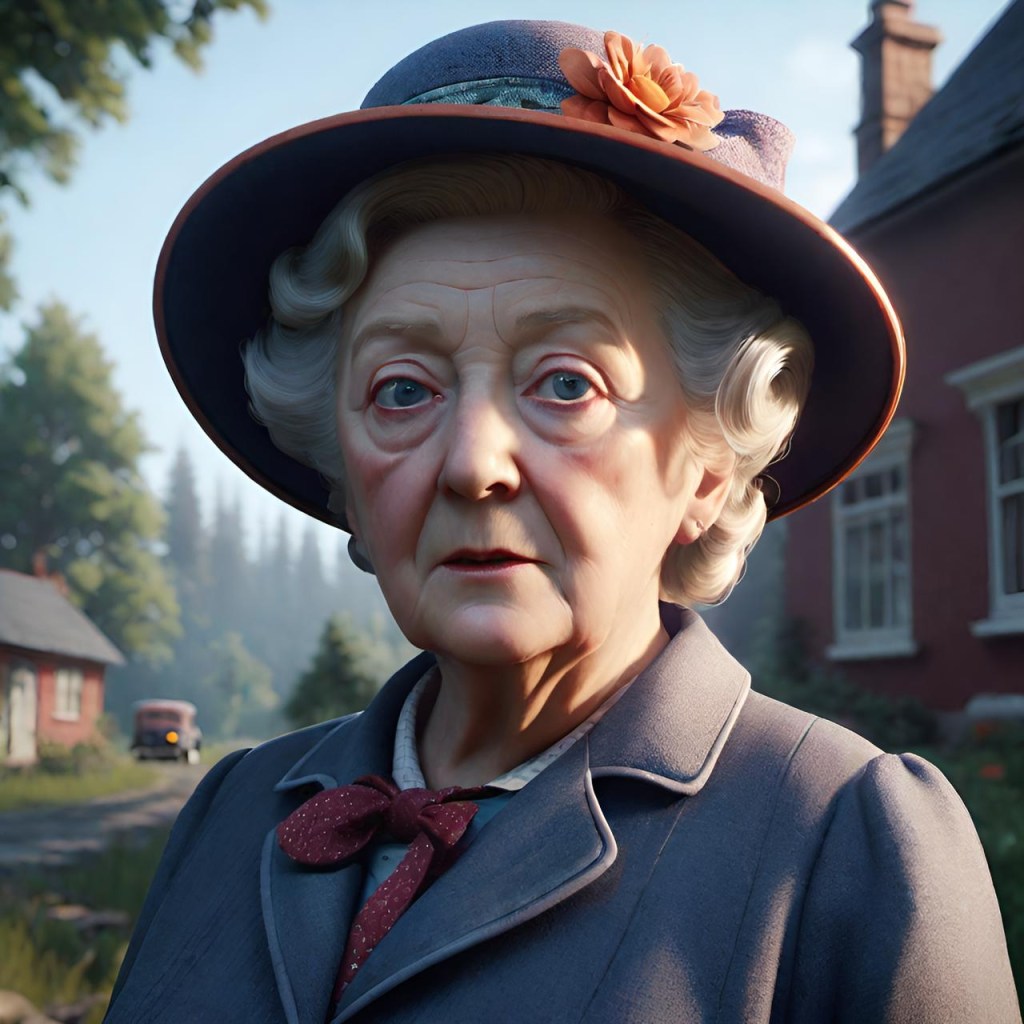
There are few detectives in literary history as unassuming—or as ruthlessly observant—as Jane Marple. Armed with a knitting bag, a gentle smile, and an encyclopedic knowledge of human wickedness, this elderly spinster from the sleepy village of St. Mary Mead solved some of the most baffling murders in British fiction.
While Scotland Yard detectives chased clues with magnifying glasses and forensic science, Miss Marple simply sat in a wing chair with her knitting needles, quietly realizing that the butcher, the baker, and the local vicar were just as capable of cold-blooded murder as any hardened criminal in London.
Here is a semi-deep dive into the character, her greatest cases, and a complete directory of her appearances across print, television, and film.
1. Who is Jane Marple? (What Makes Her Tick?)
When Agatha Christie introduced Jane Marple in 1930, she did not look like a mastermind of criminal profiling. She was frail, polite, elderly, and lived a quiet provincial life.
Yet, that was her greatest weapon. People underestimated her. Servants gossiped in front of her, suspects dismissed her as a harmless busybody, and police inspectors initially viewed her as an irritating nuisance.
What made Miss Marple tick was her absolute, unshakeable philosophy on human nature: Human beings are the same everywhere.
Having spent her entire life observing the small-town gossip, petty jealousies, and dark secrets of St. Mary Mead, Marple realized that a village is merely a microcosm of the entire world. The malicious village postmistress possesses the exact same psychology as a corporate embezzler or a sophisticated serial killer. She didn’t need a forensic lab; she needed a human sample size.
2. Why Do Fans Love Her?
- The Power of Underestimation: Fans love a protagonist who outsmarts arrogant authorities. Inspector Slack and even Hercule Poirot at times initially rolled their eyes at her knitting, only to watch her dismantle an airtight alibi with a polite observation about village parish politics.
- Absolute Moral Clarity: Miss Marple was unfailingly polite, but she possessed a spine of steel. She wasn’t fighting for glory or a police pension; she fought for justice and the protection of the innocent.
- The Comfort of St. Mary Mead: Reading a Marple mystery offers a cozy, atmospheric escape into English tea rooms, garden parties, and country manors, even as a body drops in the library.
3. Complete List of Books and Short Stories
Agatha Christie featured Miss Marple in 12 novels and 20 short stories (collected in two main volumes).
Novels
- The Murder at the Vicarage (1930)
- The Body in the Library (1942)
- The Moving Finger (1943)
- A Murder is Announced(1950)
- They Do It with Mirrors (1952)
- A Pocket Full of Rye (1953)
- 4.50 from Paddington (1957)
- The Mirror Crack’d from Side to Side (1962)
- A Caribbean Mystery (1964)
- At Bertram’s Hotel (1965)
- Nemesis (1971)
- Sleeping Murder (Written circa 1940, published posthumously in 1976)
Short Story Collections
- The Thirteen Problems (1932): Contains 13 stories featuring the “Tuesday Club Murders” (including “The Tuesday Night Club”, “The Idol House of Astarte”, “Ingots of Gold”, “The Bloodstained Pavement”, “Motive v. Opportunity”, “The Thumb Mark of St. Peter”, “The Blue Geranium”, “The Companion”, “The Four Suspects”, “A Christmas Tragedy”, “The Herb of Death”, “The Affair at the Bungalow”, and “Death by Drowning”).
- Miss Marple’s Final Cases and Two Other Stories (1979): Contains 8 stories (including “Sanctuary”, “Strange Jest”, “Tape-Measure Murder”, “The Case of the Caretaker”, “The Case of the Perfect Maid”, “Third Floor Flat”, “The Adventure of Johnnie Waverly”, and “The Dressmaker’s Doll”).(Note: A few additional stray short stories featuring Marple were published in various magazines and later anthologized).
4. Complete List of TV, Film, and Other Media
Jane Marple has been brought to life by legendary actresses across generations on stage, film, and television.
Feature Films
- Margaret Rutherford Films (MGM, 1961–1964):
- Murder, She Said (1961 – based on 4.50 from Paddington)
- Murder at the Gallop (1963 – based on After the Funeral, originally a Poirot novel)
- Murder Most Foul (1964 – based on Mrs McGinty’s Dead, originally a Poirot novel)
- Murder Ahoy! (1964 – an original screenplay)
- Angela Lansbury Film:
- The Mirror Crack’d (1980 – feature film adaptation starring Lansbury before she became television’s Jessica Fletcher).
- Helen Hayes Television Films:
- A Caribbean Mystery (1983)
- Murder with Mirrors (1985)
Major Television Series
- The BBC Series (Miss Marple, 1984–1992):
- Starring Joan Hickson, widely considered by purists to be the definitive, most faithful adaptation of Christie’s literary character. Adapted all 12 original novels across 12 feature-length episodes.
- ITV Series (Agatha Christie’s Marple, 2004–2013):
- Starring Geraldine McEwan (Series 1–3) and later Julia McKenzie (Series 4–6). This series took more liberties with plots, occasionally turning non-Marple books into Marple stories or adding contemporary television flair.
Stage Plays & Radio
- Numerous theatrical stage adaptations have run in London’s West End and worldwide, starting with The Murder at the Vicarage stage play in 1949.
- The BBC Radio 4 has broadcast full-cast dramatizations of nearly every single Miss Marple novel, featuring acclaimed actresses like June Whitfield in the title role.
(Looking to bring classic mystery and high-energy interactive entertainment to your next private event, party, or corporate gathering? Reach out to us today at murder2nite.com to check availability and book your own live-action whodunnit!)


 Murder Mystery Events